Meet Our New Member Outreach Organizer

The Campaign Now Has a Member Outreach Organizer!

Madison Gonya.jpeg

Madison Gonya grew up in Rio Rancho and graduated from the University of New Mexico in 2020. She is now pursuing her master’s degree in health care administration, also at UNM. She is particularly interested in systemic health care reform, which brought her to us.

As our new member outreach organizer, Madison will be working with the Campaign’s member organizations to make sure they are up to date on Health Security developments, are knowledgeable about how they can help to move Health Security forward, and have what they need to engage and inform their own members and communities.

A big welcome to Madison!

May 2022 update: Madison received her master’s degree in May 2022 and is now working full-time for UNM.

Fall Zoom Series Off to a Great Start!

Fall Zoom Series Off to a Great Start!

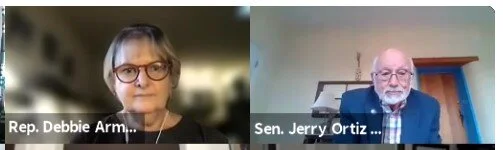
Our fall Health Security Plan Design series began last week with a conversation with Health Security champions Rep. Debbie Armstrong and Sen. Jerry Ortiz y Pino. We had almost 80 participants on Zoom, and some great questions for our two guests.

One of those questions was about how we can recruit more doctors to our state.

In his response, Sen. Ortiz y Pino spoke of some of the selling points he sees our state as having under Health Security: "If we had better reimbursement levels, if we have a simpler system that doesn’t put so many demands for paperwork on the doctors, if we have a system in which they are able to practice at the top of their scope of work, their skill level, that would make New Mexico very attractive, I think, and would help us recruit better and retain the ones we have."

We are so grateful to Sen. Ortiz y Pino and Rep. Armstrong for being our speakers at the meeting. They closed with hopeful and forward-looking thoughts:

Rep. Armstrong: "This is further than we've ever been before… As the bill had been introduced over the years, this is the work that was contemplated of the commission. We're just doing it first, before getting a commission on board… It doesn't work just to do--as we found out--just to do a fiscal analysis if you don't have the underlying questions and assumptions pinned down. This is great work. I would just say, it's been my honor to be a champion."

Sen. Ortiz y Pino: "We're getting very close. We're not talking in terms of theory anymore. We're talking now about how this [the Health Security Plan] would look in an actual plan that we can put down on paper and take to the legislature and say, 'Here we are: step 1, step 2, step 3. And this is what the costs estimates are for this. And these are the federal laws that we have to get waivers from… And this is the way it can be done, a blueprint, a roadmap if you will, about how to get there.'"

A recording of the meeting can be viewed below. (While the live meeting spotlighted our speakers and moderator, the recording shows gallery view.)

Key Legislators to Share Health Security Advances

What’s the Latest on the Health Security Design Process?

On Wednesday, September 29, Rep. Debbie Armstrong and Sen. Jerry Ortiz y Pino will kick off our fall Health Security Plan Design Process series, which will be held via Zoom.

These dedicated Health Security Act sponsors have been instrumental in moving the Health Security planning & design phase forward. They’ll be talking about what’s currently happening with the design process and what they’re envisioning as we move ahead.

The 2021 legislature allocated $575,000 to the Office of the Superintendent of Insurance to begin the Health Security design process. This first year focuses on four priority research areas. Through discussions with the Superintendent of Insurance, Rep. Armstrong and Sen. Ortiz y Pino have been actively involved in guiding this process.

Register here to attend the September 29 meeting (6:15-7:30 PM).

Health Security Design Process: Latest News & Priority Areas

The Latest on the Health Security Design Process

We are working hard to ensure that the Health Security Plan design process gets underway as quickly as possible. The Office of the Superintendent of Insurance, which is supervising this process, is actively searching for the right consultants to begin the required research to create our innovative homegrown plan.

This is a very new phase in the history of our Campaign. We are working closely with the Office of the Superintendent, doing everything we can to make sure the Plan design is conducted in a way that is transparent and provides for public input.

Current Status

Rep. Debbie Armstrong, Sen. Jerry Ortiz y Pino, and several of us from the Health Security for New Mexicans Campaign met with the Superintendent of Insurance, Russell Toal, and some of his staff earlier in the summer.

The Superintendent wants to hire consultants to get going with the design process ASAP rather than wait for an advisory council to be created (which will take some time to set up). We raised the importance of an advisory council in terms of oversight. Transparency and public input are key factors in this process to design our own New Mexico health plan!

We presented several issue areas that we considered top priority to research. The Superintendent felt that researching the first four priority issue areas would be reasonable in the first year. Others will have to be researched in subsequent years of this multiyear process.

Priority Design Areas

Below are the top four priority issue areas to be researched this year (the fiscal year ends June 30, 2022). The focus is on coming up with initial design ideas, not – at this time making decisions on the best path forward.

AdobeStock_243374689--free license.jpeg

1. Investigation of federal waivers and agreements (regarding Medicaid, Medicare, and the Affordable Care Act’s Waiver for State Innovation, etc.) that will set the parameters of what we can and cannot do. Obviously, we want to maximize federal funding, and compliance with current regulations is necessary to make the Health Security Plan a reality.

2. Research that identifies all the topics and data required to be able to conduct a solid cost analysis of the Health Security Plan. After the structure and details of the Health Security Plan have been determined, a cost analysis will need to be conducted of the Plan as designed (not as projected, which is what the three existing studies analyzed). By identifying what data points will be needed to do that analysis, we can make sure that all that information is collected. This research area should result in an overall blueprint of what needs to be done.

3. Exploration of provider payment system methodologies, taking into consideration different settings – private practices, independent group practices, group practices affiliated with hospitals, and salaried health care providers (such as salaried physicians who work for hospitals).

This research should include the pros and cons of fee for service, value-based options, and other payment mechanisms, including an all-payer rate payment system. (An all-payer system sets uniform reimbursement rates that apply to all health care providers and to all payers, or insurers, in a state.)

This line of research should provide a range of options that might possibly work across settings and simplify what has become a complicated and error-prone coding system. The coding systems currently used by public and private insurers are complex, costly, time consuming and frustrating for providers, and take time away from patient care.

4. Research on global budgets for hospitals. Global budgets are another name for fixed operating budgets. Under a global budget system, hospitals and other health facilities have a predictable, sustainable revenue stream to cover their costs; they no longer need to rely on a complex fee-for-service system.

Senator Ortiz y Pino’s 2021 global budgets bill (SB 351), which was introduced late in the session, would have created a task force whose goal was to come up with a global budget system that works for New Mexico and to request funding from the Centers for Medicare & Medicaid Services (CMS) to develop it. Both Maryland and Pennsylvania have received substantial multiyear funding to develop such a system (within the current private insurance structure). The New Mexico Hospital Association testified in favor of SB 351, and this approach is expected to especially help rural hospitals in our state.

The priority issue areas that we had identified included two beyond the four that Superintendent Toal feels are doable within the first year. These two additional areas are bulk purchasing of drugs, medical equipment, and supplies, and IT system requirements. Rep. Armstrong has noted that the interim Legislative Health and Human Services Committee will be working on the issue of bulk purchasing of drugs, so hopefully that will be moving forward separately.

Additional areas to be researched can be found here. Everyday New Mexicans, medical professionals, and state legislators need to have full information on what the options are before making decisions on what the Health Security Plan will include!

We are proud that New Mexico is the first state to take the groundbreaking step of developing its own health plan – and we know this wouldn’t be happening without the dedication of Health Security supporters across the state. Thank you!

State-Based Universal Health Care Act Introduced

Federal legislation.jpg

Last week, Congressman Ro Khanna introduced the State-Based Universal Health Care Act (H.R. 3775). This bill would make it easier for states to receive the needed federal waivers and funds to develop their own health plans to provide coverage to state residents.

“Recognizing the unique position of American states to lead the push for universal health care, Rep. Khanna’s bill provides states with historic access to federal funding streams and regulatory flexibility necessary to implement and support affordable, universal health care plans,” states the press release introducing the bill.

If the last year proved anything, it is that universal health coverage is not optional: it’s urgent,” said Rep. Ro Khanna. “We’ve seen the power in providing unfettered and uncomplicated access to rapid testing, treatment, and vaccination during the COVID-19 pandemic. As the wealthiest nation on earth, we must extend that kind of coverage to the whole of our health care system. That’s why I’m proud to reintroduce this critical legislation and give every state in this nation the power to provide coverage for their residents.”

We are asking our congressional delegation to support this legislation and to sign on as co-sponsors.

Design Phase Update!

Design phase.jpg

As you know, the 2021 NM legislature appropriated $575,000 to begin the design process of the Health Security Plan. While the 2019 Health Security Act laid out the framework for the Health Security Plan, there are a lot of operational details still to be worked out before enrollment can begin.

The NM Office of Superintendent of Insurance is responsible for overseeing this process. We have had several discussions with key legislators and have been working closely with Rep. Debbie Armstrong and Sen. Jerry Ortiz y Pino to provide guidance to Superintendent of Insurance Russell Toal and his staff.

At the end of May, we had a good meeting with the Superintendent about the Health Security design process. We discussed what might be accomplished this year, and what the priorities are as this multiyear process begins. The Office of Superintendent of Insurance is currently developing a work plan for our review.

We are so excited to see the design work begin! This is the first time in the United States that a state is rolling up its sleeves to figure out the details of a plan that will automatically provide comprehensive coverage to most residents.

Supreme Court Again Upholds Affordable Care Act

For the third time, the Affordable Care Act has survived a challenge in the Supreme Court.

Court.jpg

The court determined that the plaintiffs—Texas and 17 other Republican-led states—did not have legal standing in the case. The court did not rule on the substance of the case, which centered on whether Congress's 2017 removal of the financial penalty for not buying health insurance meant that the entire law was unconstitutional.

This is great news for the roughly 20 million people who would have lost health care coverage if the ACA had been struck down. The ACA, of course, also protects those with preexisting conditions, forbids copays for certain preventive care services, and prohibits lifetime caps on benefits, among other advances.

For a full explanation of the case, see this morning's coverage from Kaiser Health News.

What's Next for Health Security?

What's Next?

As we’ve noted before, the $575,000 legislative appropriation for Health Security planning and design goes to the Office of the Superintendent of Insurance.

So what's next? The next step for the Campaign is to work with Rep. Armstrong and Sen. Jerry Ortiz y Pino to set up a meeting with the Superintendent's office to discuss the Health Security planning and design processand to ensure that the process is transparent and includes public input.

This is an exciting new phase for Health Security. Advocacy and education will still be the Campaign's focus, but with special attention on the specifics of how to create our own health plan. This may sound complicated, but all of us have personal experience with the current dysfunctional system!

At this stage, we all need to think about how we would like the critical provisions of the Health Security Plan to be designed—provisions that will allow easy access to comprehensive coverage, ensure choice of health care provider, address the needs of those from rural and underinsured areas of the state, and simplify what has become a complex and costly approach to health care.

A New Zoom Series

Designing image.jpg

To provide you with the information and background you'll need to evaluate the best approaches to achieve these design goals, we'll be offering a new interactive Zoom series on various design options for some of the key provisions of the Health Security Plan. We'll be inviting outside guests who are knowledgeable about these issues and about different ways to build our own health plan.

This is a challenging task—and a great opportunity. To succeed, we'll need your involvement and input to ensure the best possible outcome for our state.

We'll keep you posted on the latest developments and our new Zoom series.

Post-Session Appreciation

"Legislative Session Yields Healthcare Wins For New Mexicans"

That's the headline of Rep. Debbie Armstrong's post-session commentary, published last weekend by KRWG. In it, she lists 8 health care wins, including funding for Health Security:

“A supplemental funding budget bill includes $575,000 for the state to plan and design an innovative program to provide healthcare coverage to all New Mexicans.”

The purpose of the Health Security Planning & Design Board Act was to set up a design process for the Health Security Plan—and that's ultimately what happened. We want to thank Rep. Armstrong, Rep. Tara Lujan, and Rep. Patricia Roybal-Caballero for sponsoring the bill.

We also want to thank those who allocated some of their Junior funds to the Health Security planning and design process:

Without these 7 representatives (and 1 more mystery representative who hasn't been identified yet!), Health Security wouldn't be moving forward this year.

And we'd especially like to thank Rep. Armstrong and Paul Gibson, of Campaign member organization Retake Our Democracy, for their instrumental role in rounding up this funding by asking sympathetic House members to consider donating a portion of their funds to developing the details of the Health Security Plan. Our executive director, Mary Feldblum, was also indispensable in this effort.

Finally, we'd like to thank you. Those of you with representatives on the House committees called and emailed their representatives, asking them to support HB 203. And so many more of you were eagerly awaiting your turn to do the same. You joined HB 203's first committee hearing to register your support of the bill and were all ready for the second hearing as well. And you stuck with us even when it was unclear what path Health Security would take. We are grateful to all of you!

thank you4.jpg

Ready for the Design Phase, Plus Global Budgets Bill

Health Security Funding in Place; Ready to Move Forward!

$575,000 for the Health Security planning and design phase is included in the junior budget bill (SB 377), which is currently waiting to be heard on the House floor. From there the bill goes back to the Senate for concurrence, and then on to the governor for her signature. Changes are not usually made to "Junior," so we're pretty confident that the funding is secure. This means we're ready for the design phase!

Appropriation in SB 377b.jpg

With less than a week left in the legislative session, it's clear that the Health Security Planning & Design Board Act (HB 203) is not going anywhere. And that's okay.

Remember, this also happened in 2019 with the Health Security cost analysis: the bill didn't pass, but the legislature appropriated funding that allowed Health Security to move forward.

Under the provisions of the $575,000 appropriation in Junior, the Office of the Superintendent of Insurance is charged with three interconnected tasks:

  • establish an advisory council

  • seek technical advice and assistance

  • research and design a system of comprehensive health coverage for New Mexico

We're looking forward to working with HB 203's sponsors—and the legislators who allocated their Junior funds to the Health Security planning and design process—and with the Superintendent's office to get things going!


Another Bill of Interest: Global Hospital Budgets Task Force (SB 351)

hospital.jpg

It's late in the game, but the Global Hospital Budgets Task Force bill (SB 351), sponsored by Sen. Jerry Ortiz y Pino, is finally on the move. It passed Senate Health & Public Affairs on Friday. (The New Mexico Hospital Association spoke in support of the legislation at the hearing.) The bill is now in Senate Finance.

Global budgets are a system under which hospitals receive a predictable and sustainable amount of revenue to cover their costs. With a guaranteed income stream, hospitals can focus on community needs rather than the most lucrative procedures (such as outpatient care and high-volume surgery).

While global budgets are a component of the Health Security Plan, they can be a part of any health care system. In fact, Maryland and Pennsylvania have received sizable grants from the Centers for Medicare and Medicaid Services (CMS) to create global budget systems. Why shouldn't New Mexico take advantage of this grant funding as well?

Given the financial problems of so many New Mexico hospitals, exacerbated by COVID-19, SB 351 proposes the creation of a Global Hospital Budgets Task Force to study global budgets and to develop a demonstration project that is tailored to our geographically large and mostly rural state. The project would be open to rural hospitals that voluntarily choose to participate. The goal is to apply for available CMS funding for the project.

If your senator sits on the Senate Finance Committee, you may want to call them and ask for their support on SB 351.

Where Things Stand: The Bill & the Funding

Health Security Status: The Bill & the Funding

THE NOT-SO-GOOD NEWS: The Health Security Planning & Design Board Act (HB 203) has still not been heard in the House Appropriations & Finance Committee.

As the session rushes toward its March 20 finish line, passage of HB 203 becomes less likely, although still not impossible. Passage would require getting out of House Appropriations & Finance, passing the House floor, passing assigned committees (probably two) on the Senate side, passing the Senate floor, and then being signed into law by the governor.


THE REALLY GOOD NEWS: We have funding for the Health Security planning and design phaseand that funding is NOT contingent on passage of HB 203.

piggy bank.jpg

The $600,000 appropriation in HB 203 was not included in the main state budget bill. When HB 203 sponsors and other supporting legislators realized that, they contributed some of the funds allotted to them toward the development of the Health Security Plan. (Each representative was allotted $175,000 to go to the programs or agencies they chose; each senator was allotted $297,000.)

The House Appropriations & Finance Committee and the Senate Finance Committee are putting together a junior budget bill with all the legislators’ allocations. This bill should easily pass both houses. HB 203 sponsor Rep. Debbie Armstrong has assured us that enough money has been contributed by legislators to fund the planning and design process.


WHAT THIS MEANS: Regardless of the ultimate fate of HB 203, the planning and design of the Health Security Plan should proceed this year!

If HB 203 passes, the Office of the Superintendent of Insurance will oversee an 11-member board of experts (appointed partly by the governor and partly by the legislature) to design the details of the Health Security Plan.

If HB 203 does not pass, the Office of the Superintendent of Insurance will oversee the planning and design process. The superintendent has a public health background, and key agency staff are familiar with the Health Security Plan's provisions.


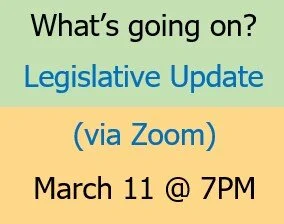
Legislative Update on Thursday (03/11), 7:00 PM

Find out the latest this Thursday, 7:00-8:15 PM.

Join us at 7:00 PM for our semi-weekly Zoom update on HB 203 and the legislative session.

Register now!

HB 203 Hearing in Appropriations (updated)

Updated March 5, 11:15 AM

HB 203 Hearing Not Yet Rescheduled

After being taken off the agenda on Tuesday, the Health Security Planning & Design Board Act (HB 203) has not yet been rescheduled for its hearing in the House Appropriations & Finance Committee.

The committee did not meet Thursday, and to our surprise, is not meeting today (Friday) either. It’s unclear at this point whether it will meet over the weekend. We will let you know as soon as HB 203 is back on the agenda.

While the legislative session ends in just over two weeks, a lot can happen in that time!

Updated March 2, 1:30 PM

HB 203 Postponed in House Appropriations

At the last minute, the hearing on the Health Security Planning & Design Board Act (HB 203) in the House Appropriations & Finance Committee has been postponed until later this week.

Hang in there—this is part of what happens during the legislative session, and we have great bill sponsors who are fighting for HB 203!

We'll let you know as soon as we know more.


HB 203 in House Appropriations This Afternoon

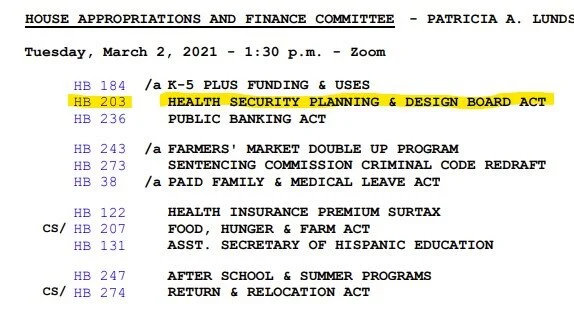
The Health Security Planning & Design Board Act (HB 203) is scheduled to be heard in the House Appropriations & Finance Committee early this afternoon (Tuesday)!

HB 203 is second on the agenda. This is a fast-moving committee, so please join the meeting promptly at 1:30 PM. They should start on time.

Zoom link: https://us02web.zoom.us/j/81049777380
Webinar ID: 810 4977 7380

It's hard to know how much public participation, if any, the committee will invite. They might take an online poll to measure support for the bill—so try to be on Zoom in case they do—or they might allow very limited testimony by a few key supporters.

If your representative is on House Appropriations & Finance and you haven't already called them, please call THIS MORNING and ask them to vote in favor of HB 203, the Health Security bill!

Just a reminder: HB 203 will set up a board to develop the details of the Health Security Plan, which will automatically provide guaranteed, comprehensive health care coverage to most New Mexicans.