FAQs

+ Why do we need the NM Health Security Plan?

While hundreds of thousands of New Mexicans have gained health coverage since passage of the Affordable Care Act (Obamacare), there are still problems to address: increases in premiums, deductibles, and copays; rising costs for prescription drugs; and smaller networks that limit patients’ choice of health care provider are just a few of them. And COVID-19 has revealed some of major gaps in our current system—not the least of which is that people who become unemployed all too often also lose their insurance coverage. As of August 2020, 11.9% of New Mexicans under 65 were uninsured (up from 10.5% in fall 2019), and many others are underinsured.

But our state has a clear path forward—setting up its own health plan that would include most New Mexicans, regardless of age, health, and employment status. The Health Security Plan is based on the old-fashioned concept of insurance, where the young, the old, the healthy, and the not-so-healthy are all in one large insurance pool. The risk is shared, while administrative costs are reduced. Our current segmented system of hundreds of insurance plans is complex and costly for all of us. Doesn’t it make sense for a state with a small population to set up its own plan?

The Health Security Plan will offer comprehensive benefits and freedom of choice of health care provider and facility, even across state lines. It will be our plan, run like a coop and overseen by a independent citizens’ commission.

For more about the problems with our current system, check out the collection of articles on our Studies & Articles page.

+ Who will be covered by the Health Security Plan?

Almost all New Mexicans will be covered, regardless of age, health status, and employment status. Federal retirees, active-duty and retired military, and TRICARE recipients will continue with their current coverage, and tribes (as dependent sovereign nations) can opt into the plan. Health plans that are covered under a federal law called ERISA can voluntarily join the plan. (Large-company plans and union plans are often ERISA plans.)

No more shopping around for plans. Most New Mexicans will be automatically covered!

+ What services will be covered by the Health Security Plan?

Covered services will be at least as comprehensive as those currently offered to state employees, including extensive preventive care, medical and hospital care, mental and behavior health care services, acupuncture, and chiropractic treatments.

Dental coverage could be purchased as a supplemental policy, as is the case with state employees. It is expected that dental coverage will be phased into the Plan in future years. (Anyone with Medicaid coverage that includes dental care will continue to have dental services covered.)

+ Will I be able to stay with my doctor?

No more networks! New Mexicans covered by the Health Security Plan will have complete freedom to choose any in-state, licensed health care provider, hospital, pharmacist, or clinic. The Health Security Plan is also authorized to contract with providers and health facilities across state lines.

+ How much will my Health Security Plan coverage cost?

A 2020 study funded by the NM legislature concluded that the Health Security Plan would reduce rising health care costs, saving up to $2.7 billion in a five-year period. This is the third New Mexico study that has come to this conclusion.

How much you will pay will depend on the findings of the fiscal analysis that is required prior to setting up the Plan. There are a lot of critical decisions to be made before the Plan can begin enrollment. The 2021 Health Security Planning and Design Board Act creates a publicly accountable and transparent process that will address these many operational details. Prior to Plan implementation, the legislature and the governor must approve a cost analysis of the Plan as designed and how it will be funded in real (not projected) dollars.

Only Health Security Plan members will pay. Premiums will be determined by income (with caps), not by age, gender, region, or health status. Premiums may be increased only with the approval of the superintendent of insurance (a public process). Employers may opt to cover all or part of an employee’s premium. Employers whose employees are covered by the Health Security Plan are also required to contribute to the cost of the Plan.

If Affordable Care Act subsidies and federal tax credits remain available, they will help also be included.

+ Will there be deductibles and copayments?

There will be no deductibles. There will be no copayments for preventive care. The Health Security Commission, after public hearings, will determine under what conditions, if any, copays would be required, and how much those copays would be. (See FAQs below for more information about the Commission.)

+ How will the Health Security Plan keep down medical costs?

Costs will be controlled in part through budgetary planning that takes into account technology, an aging population, and other factors. A Quality Improvement Program must be established, with provider input, to ensure best medical practices and patient safety.

Hospitals, clinics, private-practice physicians, pharmacists, and other providers will negotiate budgets and fees with the Health Security commission. The NM Health Security Plan will pay the bills. The Plan may contract with a private company to process claims, but only if the claims are processed in New Mexico.

The Health Security Plan will buy pharmaceutical drugs and medical equipment in bulk to reduce costs.

Administration will be streamlined because almost everyone will be covered by the same health care plan, with one claims form. Savings will result from the elimination of duplicative administrative costs built into the present system of multiple insurance plans. Money that was formerly used for insurance company marketing, commissions, out-of-state investments, and profits will be made available for health care services. In the sixth year of operation, the administrative costs for the Health Security Plan will be limited to 5% of its annual budget.

+ What about surprise out-of-pocket costs?

No more surprise billing! The Health Security Act specifically prohibits any health provider or health facility that has an agreement with the Plan from charging patients more than the covered rates. (And remember, this includes out-of-state providers and facilities that the Health Security Plan—like any insurance plan—will have negotiated fees with.)

+ I understand that automobile insurance and workers compensation premiums will be reduced under the Health Security Plan. Why?

If you are in a car accident and break your leg and your plan covers the care you need for the broken leg (which the Health Security Plan would do), you would not have to file a health claim with your auto insurance company. There is no need to pay for duplicate health coverage, so the health portion of your auto insurance premium can be reduced.

For employers participating in the Health Security Plan, commercial auto insurance and workers compensation premiums will be reduced, since the plan will be paying the health portion of these bills.

+ What will happen to medical records?

Federal and state medical privacy laws will apply. However, because almost all New Mexicans will be in one confidential medical database, providers (including emergency room staff) will know what tests you have taken, what meds you are on, and other critical medical information. This should lead to better and more coordinated care for patients and should also save the Health Security Plan money, as there should be no duplication of services. The centralized, confidential database will also be useful to pharmacists, who will immediately have your prescription record.

+ Who will run the Health Security Plan?

An independent citizens' commission will be responsible for the operation of the Health Security Plan. Its meetings will be open to the public, its budget will be public, and it won’t be able to make changes or additions to the plan without public input. Think of it as a cooperative.

+ How is the Health Security Commission formed?

First, a geographically representative nominating committee will be chosen by majority and minority legislative leaders of both houses. No one with insurance interests can sit on the nominating committee or on the Health Security commission. The nominating committee will select candidates for the commission. Ten of the 15 commissioners must reflect consumer and business interests (with at least six of the ten reflecting consumer interests); the other five commissioners will represent provider and health facility interests. The commissioners will be selected from public education districts across the state in order to make sure that the commission is geographically representative. Most importantly, all members of the nominating committee and the commission must be eligible for or enrolled in the Health Security Plan.

+ How can I sign up for the Health Security Plan?

The Health Security Plan is not yet active. The 2021 Health Security Planning and Design Board Act will set up a board with the expertise to make decisions on some of the key details of the Health Security Plan. The Planning and Design Board will be in place for two years and will then hand things over to the Health Security Commission to finish the design phase and start enrollment in the Health Security Plan.

+ How can I help make Health Security a reality?

  1. Be as informed as you can. Sign up for our email list. Then sign up for a workshop or informational meeting on Health Security!
  2. Talk to everyone you know about Health Security. Tell them why you think it will work for all of us in the state. One of our biggest challenges is lack of awareness about this important New Mexico alternative.
  3. Let your legislators and the governor know that you support the Health Security Plan, and ask them to support it too.

+ Is it legal for New Mexico to create its own plan?

There is a Waiver for State Innovation provision in the Affordable Care Act that allows a state like ours to develop a plan like Health Security and still receive federal dollars. The Health Security Plan meets the criteria for such a waiver, and the US Health and Human Services Department (which must approve any waivers) is likely to be supportive under the Biden administration.

+ What's the difference between the Health Security Plan and Medicare for All?

Medicare for All would create a national health plan. There are two Medicare for All bills in Congress, one in the House and one in the Senate. There are some differences between them (the Kaiser Family Foundation has a great comparison tool). Congress is able to change federal laws, so it could mandate the automatic inclusion of Medicare and Medicaid, for example. It could also require companies that are self-insured and come under the federal ERISA law (and so are exempt from state laws) to be included as well. State plans cannot change federal laws, so they have to work within the existing legal frameworks. Therefore, the Health Security Plan allows ERISA plans to voluntarily join the Plan, but it cannot require them to join.

With the current makeup of the Senate, the likelihood of Congress passing a Medicare for All bill is probably low in the near future. Moreover, there is a big advantage for our state to create a plan that works for us. In the United States, the states have often been leaders in reform. Passage of laws at the state level has been an effective way to pressure Congress to pass national laws for civil rights, women’s suffrage, labor reform, etc. Canada’s national plan came after the different provinces developed their own plans. (It was the poorest province, Saskatchewan, that started the ball rolling!)

+ What about Medicaid Buy-In?

The Medicaid buy-in proposal would allow New Mexicans who are not currently eligible for Medicaid to buy into this public insurance program. (Medicaid is a federal program, administered by the states, that provides health care coverage to lower-income and disabled Americans. Under the Affordable Care Act, Medicaid was expanded to include those earning up to 138% of the federally designated poverty level; this amounts to $36,156 for a family of four. Medicare, in contrast, is a federal program that provides health care coverage to older Americans, beginning at age 65, and some younger Americans with disabilities.)

After passage of the Health Security Planning and Design Board Act, it will take three to four years for the Health Security Plan to be up and running. In the meantime, it's important for as many New Mexicans as possible to have health coverage. That's where Medicaid buy-in could help. There are an estimated 214,000 people without health care coverage in our state. Allowing people to pay into the Medicaid system to gain access to good health coverage would help close that gap. People would pay a premium, as they do with private insurance, to buy into Medicaid.

+ I'm covered by Medicare. What would the Health Security Plan mean for me?

In order for Medicare recipients to be included in the Health Security Plan, agreements will need to be reached with the federal government to safeguard recipients’ rights. Negotiations will also need to be undertaken regarding Medicare supplements (whether from a former employer or purchased individually) so that retirees do not lose any benefits they are entitled to.

For these reasons, Medicare recipients might not be included in the Plan right away.
1-Page Overview

The New Mexico Health Security Plan

Rising premiums and copays, shrinking provider networks, no end in sight to drug price increases, and more and more plans with high deductibles – that’s what New Mexicans are facing today. Not only that, but the COVID-19 pandemic has shown us how little we can rely on employer-based health insurance, which can disappear when you need it most. The demand for new approaches has taken center stage.

The New Mexico Health Security Plan, which has been vetted by diverse New Mexicans for years, provides a well-thought-out solution. Three studies, the most recent in 2020, have concluded that covering all or most state residents through one plan controls rising health care costs. The latest study estimated savings of up to $2.7 billion over a five-year period with the Health Security Plan. And with Health Security, virtually all New Mexicans would have health care coverage.

The big picture:

The Health Security Plan will automatically cover most New Mexico residents. Exceptions are federal retirees, active duty and retired military, and TRICARE recipients, all of whom will continue with their federal plans. The tribes, as sovereign nations, may choose to join the Plan. Health plans covered under ERISA also have the option of joining the Plan.

The Plan shifts private insurance to a supplemental role, just as traditional Medicare does. Plan members have guaranteed, comprehensive, quality health care coverage, regardless of income level or health and employment status.

Developing the details:

While the framework of the Health Security Plan has been developed over the years – and is outlined in the 2019 Health Security Act – many details of the Plan have not yet been fleshed out.

In 2021, the legislature set aside $575,000 to pay for the first year of the Health Security planning and design process. Under the auspices of the Office of the Superintendent of Insurance, this process will focus on the operational details of the Plan – such as how providers will be paid, how budgets for hospitals will be negotiated, and the appeal rights of consumers. It will also determine public and private revenue sources to fund the Plan and will determine any waivers that the state will need to apply for.

The Health Security for New Mexicans Campaign’s focus is to ensure that this is a transparent and publicly accountable process that takes into account the input and needs of New Mexicans across the state.

The Health Security Plan:

  • Guarantees choice of provider, even across state lines (no more networks)

  • Guarantees an excellent benefit package that must be as comprehensive as the services offered to state employees

  • Preserves the private delivery system (private physicians, hospitals, etc.)

  • Provides strong protections for retirees

  • Reduces overhead costs for health care providers and facilities

  • Calls for reductions in workers compensation and automobile insurance premiums

  • Will be run by an independent, nongovernmental commission with 15 geographically representative commissioners

Plan Summary

Health Security Plan Summary
(
Based on the 2019 Health Security Act)

Universal Coverage:

  • All New Mexico residents will have guaranteed health care coverage. Most residents will be automatically covered by the New Mexico Health Security Plan.
    Exceptions:

    • Federal retirees, active and retired military, and TRICARE recipients will retain their plans.

    • Employers and unions with plans covered under ERISA are allowed to join the Plan.

    • Tribes, as sovereign nations, may choose to participate in the Plan.

  • Federal agreements will be sought so that Medicaid and Medicare may be included in the Plan and recipients will not lose any federal rights. Because negotiations around Medicare will be complex, Medicare recipients might not be included in the Plan initially.

Health Coverage:

  • Everyone covered by the NM Health Security Plan will receive the same comprehensive benefits, regardless of age, income, employment, or health status. Coverage must be at least as comprehensive as the state employees’ health plan. Services will include doctor visits, hospital stays, prescriptions, preventive care, lab work, and specialist services.

  • Current Medicaid long-term care coverage will continue, as well as private long-term care insurance. There is a parity requirement for behavioral health care benefits. Recipients of Medicaid behavioral health coverage will not lose any entitled benefits. The Commission that will administer the NM Health Security Plan must develop a plan to coordinate behavioral health services and to integrate long-term care services into the Plan.

  • NM Health Security Plan members and employers may buy supplemental health coverage on the private insurance market, should they wish to do so.

Rural Access:

  • For rural and underserved areas, the Commission may authorize higher reimbursements for physicians and other licensed health care providers, and may expand budgets for hospitals and clinics. The Health Resource Certification Program ensures that major capital investments (equipment, buildings, etc.) will be made where they are needed.

  • Cost containment measures will result in savings that can be invested in needed health care services.

Public Accountability:

  • An independent commission is responsible for administering the New Mexico Health Security Plan. The Commission will have the flexibility of the private sector and be publicly accountable. The 15 voting commissioners will be geographically representative of the state. A special nominating committee will provide the governor with a list of potential qualified nominees. Ten of the 15 commissioners must reflect consumer and business interests; the other 5 will represent provider and health facility interests. Commissioners must be covered under the Plan.

  • Regional councils will be created with local input. These councils make recommendations to the Commission about specific local health care needs. They work with the Commission to develop and update provider fees and health facility operating budgets.

  • The Commission must submit rate changes to be reviewed and approved by the superintendent of insurance.

  • Under the Plan’s global budgeting provision, providers and health facilities negotiate fees and budgets with the Commission. If agreements cannot be reached, the Plan provides for mediation. Providers and health facilities make their own decisions about budget allocations for services and the health needs of the patient.

  • The Commission must establish appeals and grievance procedures and consumer, provider, and health facility assistance programs. All Commission meetings will be subject to the Open Meetings Act. Its books and decisions will be subject to public input and scrutiny.

Freedom to Choose Providers:

  • New Mexicans covered by the Plan have complete freedom to choose their licensed health care provider, hospital, pharmacist, or clinic. The NM Health Security Plan can contract with providers and health facilities across state lines.

Portability:

  • If a New Mexican moves out of the state: These individuals can sign up for insurance in the state to which they move, either through their employer, through a state program such as Medicaid, or through private insurance carriers. Federal health benefit recipients, including Medicare beneficiaries, will continue to receive coverage, as required by federal law. Employer supplemental health benefit packages will remain in force for retirees who have them.

  • If a New Mexican is injured or becomes ill when out of the state: The out-of-state hospital or physician will bill the Plan. The Plan will pay the negotiated rate.

  • If a New Mexican needs medical treatment out of the state: The Commission negotiates with out-of-state physicians and hospitals. New Mexicans who live near the state line and normally utilize services offered in an adjacent state can continue to do so. There will be no extra hidden charges.

  • Within the state: New Mexicans covered by the Plan who change jobs, move, or become unemployed still receive the same benefits and remain with the provider of their choice.

Cost Containment and Quality of Care:

  • Costs are controlled through budgetary planning that takes into account technology, an aging population, and other factors. A Quality Improvement Program must be established to ensure best medical practices and patient safety.

  • Hospitals, clinics, private-practice physicians, pharmacists, and other providers negotiate budgets and fees with the Commission. The NM Health Security Plan pays the bills. It may contract with a private company to process claims, as long as the claims are processed in New Mexico.

  • Bulk purchasing of drugs and other medical equipment and supplies also lowers costs.

  • Review of major capital spending for buildings and equipment will ensure that resource allocation is based on the health care needs of different communities.

  • Administration is streamlined because almost everyone is covered by the same health care plan, with one claims form. Savings will result from the elimination of duplicative administrative costs built into the present system of multiple insurance plans and policies. Insurance company monies, formerly used for marketing, commissions, out-of-state investments, and profits, are made available for health care services.

Fair Financing:

  • The NM Health Security Plan will be funded by combining existing public monies (such as funding for Medicaid and, when included in the Plan, Medicare) with employer contributions and individual premiums. If Affordable Care Act federal subsidies and tax credits are available, they will also be included. Only those covered by the Plan pay into the Plan.

  • Employers may cover all or part of an employee’s premium. Premiums will be determined by income (with caps), not by age, gender, occupation, region, or health status. Premiums and employer contributions may be increased only with the final approval of the superintendent of insurance. Employer contributions will be based on payroll and number of employees (with caps).

  • The Plan prohibits additional billing (“balance billing”) by providers and hospitals that treat Plan members. There are no copays for preventive care. Copays for other services may be established only after public hearings are held.

  • The NM Health Security Plan requires that the NM superintendent of insurance lower automobile and workers’ compensation premiums, which have large health components.

  • In the year before the Plan is to begin operations, the Commission will undertake a final cost analysis of the Plan.

Advantages for Businesses

How the Health Security Act Benefits Businesses

Healthy employees are important to all businesses, and, big or small, all businesses are impacted by rising health care costs. The fewer the employees, however, the harder it is to offer affordable coverage. And if one person has an expensive illness, that raises the premium for everyone in the group.

The COVID-19 pandemic has exposed the many flaws of our current health care system. Our hospitals, especially in rural areas, are in financial trouble. Physicians are frustrated and tired of dealing with so many different health plans. The number of uninsured New Mexicans is increasing. And health costs, including for drugs, continue to rise. These are systemic problems that require a systemic solution.

In a state with a small population, it makes sense to create a self-insured plan that will cover most of our residents, simplify this complex system, control rising health care costs, and provide secure, comprehensive coverage. That is what the Health Security Plan will do.

What is the Health Security Plan?

The NM Health Security Plan will automatically cover almost all New Mexico residents.

Exceptions: Federal retirees, active-duty and retired military, and TRICARE recipients will continue with their federal plans. The tribes, as sovereign nations, may choose to join the Plan. Large-employer health plans covered under ERISA have the option of joining the Plan.

The Plan will provide comprehensive health care coverage (no less than the services offered to state employees), with freedom of choice of health care provider, including across state lines (no more networks!). This approach is similar to what large companies do when they self-insure. The plan, which is not government-run, will operate like a co-op. Employers may offer supplemental policies to employees, just as Medicare did when it was first established.

How will it be paid for?

Funding sources include federal and state monies spent on health care; individual premiums, based on income (with caps); and employer contributions, based on payroll and number of employees (with caps).

Insuring most New Mexicans in one plan reduces rising health care costs.

A recent legislative-sponsored study concluded that the Health Security Plan will reduce rising health care costs, saving up to $2.7 billion in a five-year period. This is the third New Mexico study that has come to this conclusion. And, virtually all New Mexicans will have insurance.

Next step: the 2021 Health Security Planning and Design legislation.

There are lots of critical decisions to be made before this Plan can begin enrollment and pay health care providers. The bill creates a publicly accountable and transparent process that will address the many operational details. Prior to Plan implementation, the legislature and the governor must approve a cost analysis of the Plan as designed and how it will be funded in real (not projected) dollars.

A go-slow process: This careful planning and design phase is estimated to take four years. Such a major change will take time, with ample opportunity for public input.

Advantages for Businesses

  • Reduces business administrative costs and time. Businesses don’t have to spend precious financial and personnel resources shopping for, administering, and monitoring health care plans.

  • Reduces other insurance costs. The Plan requires reductions in premiums for other insurance policies that have health-related components, such as workers’ compensation and automobile insurance policies.

  • Stabilizes health care costs. With more than 1.7 million New Mexicans in the same insurance pool, risks are shared and costs are stabilized. Savings will enable businesses to invest in jobs and expansion.

  • Business participation. Business owners have input into this publicly accountable plan. Ten business and consumer interests must be represented on the geographically representative 15-person commission that is responsible for administering the Plan.

  • Reduces employee absenteeism due to illness. The Plan emphasizes preventive care.

  • Ability to attract and retain quality employees. Since health coverage is now included, businesses of all sizes gain a recruitment and retention advantage.

Patchwork solutions will not solve the rising health cost problem!

We are all impacted by rising drug costs, by hospital financial challenges that reduce nursing staff, by physicians who are stressed and frustrated with a complex system that forces them to make decisions based on what is covered by a particular policy rather than what is best for the patient. Increasing health care costs impact our state budget. Controlling those costs will free up funds to invest in education and job creation.

A great investment for New Mexico. The Health Security Plan offers a well-thought-out homegrown solution that is supported by over 170 organizations around the state. Creating one large health risk pool simply makes sense.

The pooling of risk is fundamental to the concept of insurance. A health insurance risk pool is a group of individuals whose medical costs are combined to calculate premiums. Pooling risks together allows the higher costs of the less healthy to be offset by the relatively lower costs of the healthy, either in a plan overall or within a premium rating category. In general, the larger the risk pool, the more predictable and stable the premiums can be.
— American Academy of Actuaries, July 2017

Health Security & Mental Health Care

Many New Mexicans are unable to get the care they need for mental health issues and substance abuse problems. The NM Health Security Plan (HSP) will help to relieve the suffering and disability caused by untreated mental health problems in our state.

Coverage for all. The HSP provides complete health coverage for most New Mexicans, but it will be especially helpful to those who have no health insurance and suffer from mental health issues and substance abuse problems. People who have severe mental illness in NM are about twice as likely to be uninsured as other New Mexicans.

More mental health care providers. The HSP will help bring psychiatrists, psychologists, and other mental health care professionals to NM. How? First, the HSP will attract them with better pay, at rates comparable to other medical providers. Second, mental health professionals want to spend their time and energy meeting with patients and giving care – not pleading with insurance company representatives or jumping through time-wasting hoops to get paid for their services. The simpler HSP approach will be a relief to these providers, and the word will spread far outside NM.

Help for rural communities. Mental health services are especially hard to get in our rural areas. To help solve this problem, the HSP calls for higher fees for mental health practitioners who work in rural (and urban) areas that are underserved.

Less expensive medications. Psychiatric medications are often very expensive – a major problem for those who need them. Through bulk purchasing, the HSP will lower the cost of these essential medicines.

Strong mental health coverage. In the past, treatment for mental health and substance abuse has often not been covered by insurance, or has been covered at a lower rate. The HSP requires that coverage for mental health be equal to coverage for other medical conditions.

Untreated mental health disorders and substance abuse issues affect all of us. Families experience tremendous strain and heartache. Workers struggle to keep their jobs and their income. Employers find it difficult to hire dependable employees. Untreated substance abuse can also lead to illegal activity, with all its harm and financial burdens.

Drug abuse tops the NM Department of Health’s list of diseases that cause death or disability in our state. Depression is #6. It’s past time to change this. Making sure that everyone has affordable access to mental and behavior health care is a giant first step. And passing the 2021 NM Health Security bill is the way to make that happen.

Advantages for Health Care Providers

NM Health Security Plan: Some Advantages for Providers

To grasp what this statewide, cooperative-style, premium-based Plan would look like, imagine the following:

  • No insurance company networks, which currently greatly complicate the lives of both providers and patients

  • One set of prior authorization and formulary rules and data sets for almost all patients we treat

  • Utilization rules made by an accountable, independent, nonprofit, geographically representative commission, with open meetings and 1/3 of its members representing provider and health facility interests

  • Every NM resident having comprehensive health coverage

  • Mental and behavioral health care being covered the same as other medical services

  • The large patient-care obstacle of out-of-pocket costs being reduced

  • Patients no longer being confused and worried about what’s covered and how their coverage works

  • Drug prices being negotiated down to reasonable levels for all patients

  • No more arguing with multiple insurers regarding the terms of “fair” contracts

  • Ready access to dispute resolution for financial issues providers might have with the Plan

  • Lower practice and hospital costs for billing and prior authorizations

  • Little wasting of health care dollars on marketing of insurance plans and their schemes to only insure the healthy 

  • Far fewer middlemen (clerks and reviewers) making health decisions

  • Elimination of most of the cost-shifting, for both inpatient and outpatient care


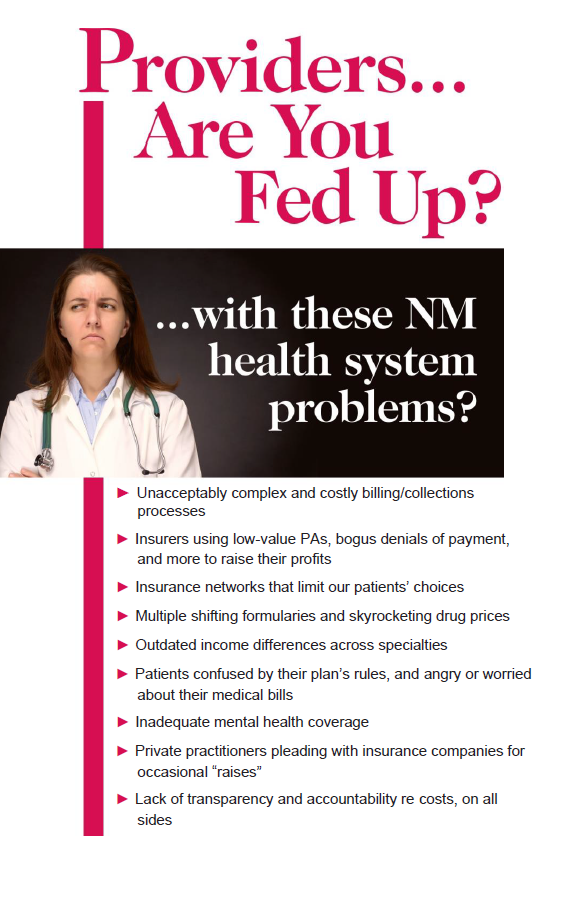
Are you a health care provider? Click on the brochure for more information.

If you’re a health care provider and have questions, please contact Executive Committee member John Mezoff, MD.